

HOA Hunter Association prospecting
Start with a territory. Keep the context through the follow-up.
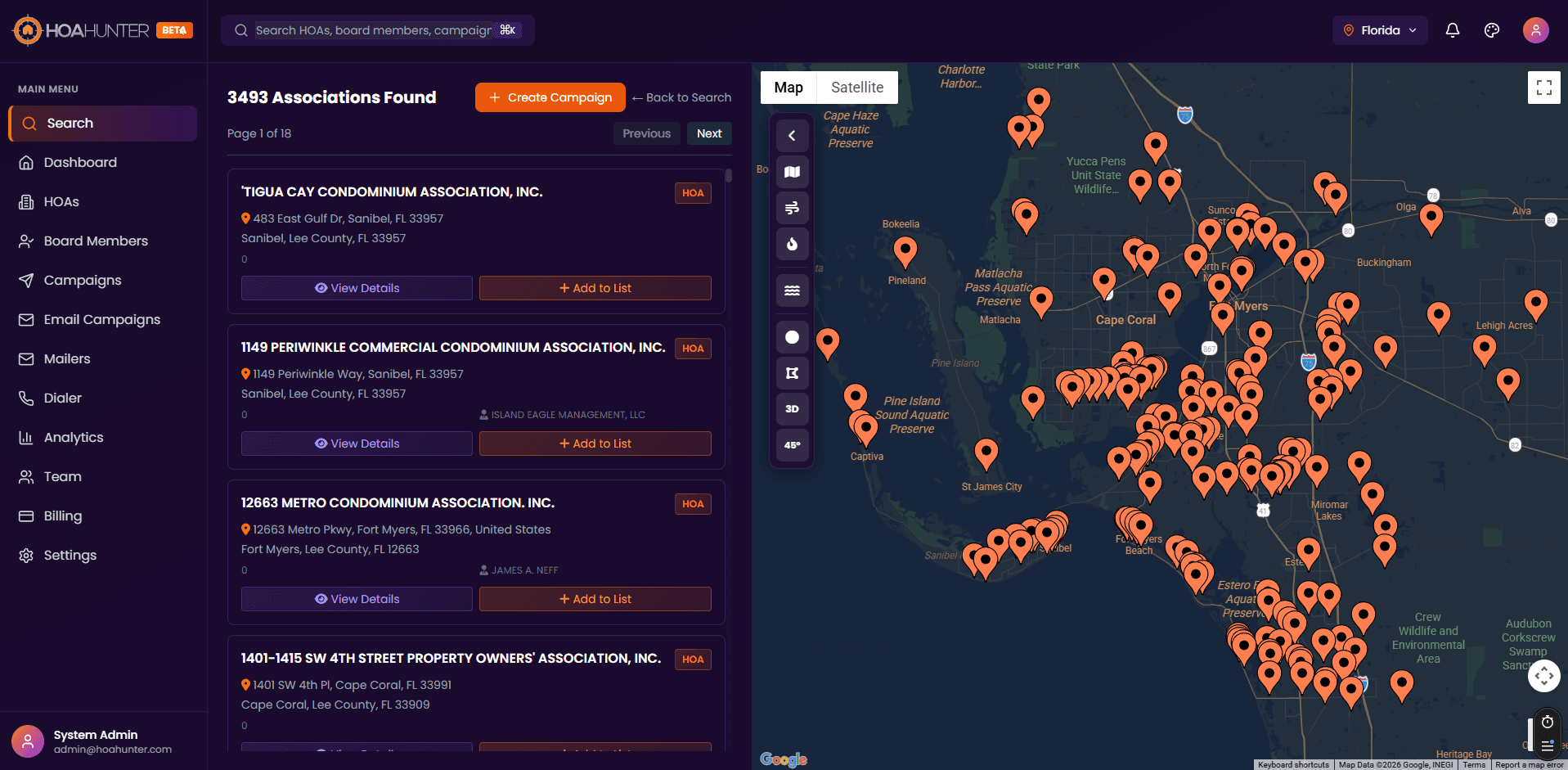
HOA Hunter connects geographic association discovery with contact records, campaign tools, and outreach history in one prospecting workspace.
- Starting point
- Map & territory
- Working record
- Association + contacts
- Continuation
- Campaign history
Finding an association is only the beginning.
An association name on a list does not explain whether the team has contacted it, which channel was used, or what happened afterward. When discovery and follow-up live in separate systems, that context can be lost as soon as the data is exported.
HOA Hunter connects the discovery workspace to the ongoing prospecting record. The association provides an organizing point for contact information and outreach activity, so the work can continue beyond the initial search.
The product is aimed at a specific market rather than a general-purpose address book. Geography, association identity, and campaign activity are linked concerns for a business developing a service territory.
What needs to survive the move from search to outreach?
Each part of the record answers a different question for the next person who opens it.
| Context | Question it answers | Why it matters |
|---|---|---|
| Geography | Is this association in the area we serve? | Keeps the prospecting territory visible |
| Association record | Which community are we working with? | Provides a shared point of reference |
| Contact information | Who can the team reach through this record? | Connects discovery to a potential conversation |
| Campaign history | What has already been attempted? | Gives follow-up a starting point |
| Contact preferences | Should this contact be excluded from an action? | Makes suppression part of the working process |
Carry the context into the next campaign.
Define the territory
Use the geographic tools to focus the search on a relevant area. A drawn boundary can reflect a service territory more naturally than a broad location label.
Organize the associations
Bring selected records into the working set. Keep the association and available contact information attached as the prospecting work develops.
Choose the outreach path
Email, calling, and direct-mail tools support different campaign actions. The useful choice depends on the team’s process and the contact information available.
Review the history
Track activity and contact preferences before the next action. Follow-up should begin with what the team already knows.
A useful prospecting system preserves uncertainty, too.
Contact information changes. A geographic match does not establish buying intent, and a database entry does not prove that every detail is current. The interface needs to help people inspect records and maintain them as they learn more.
HOA Hunter includes suppression and do-not-contact settings as part of the workflow. Those tools help teams manage their records; they are not a guarantee about the legality or suitability of a particular campaign.
The distinctive product decision is to keep geographic discovery and campaign memory in one place. A team member returning to an association record can work from the territory, contacts, and activity already collected instead of starting again with an exported list.
For your business
Does your prospect list lose its history after export?
Connect the place you find a prospect to the place you record the next conversation. Shared context makes follow-up easier to understand and coordinate.
Services behind this work
- Custom Business Software
Connect quoting, scheduling, job records, and invoicing around your actual workflow.
- AI & Operations Consulting
Decide what to improve, connect, or build before committing to a platform.
Continue exploring
- HOA Cloud
One community. Several kinds of access.
- Cougar Companies
A public website and the business system behind it.